

Bypassing the Conscious Mind to Directly Target the Electrical Roots of Mental Illness
If you are living with a severe mental health condition, you likely know the frustration of traditional “trial and error” treatments. You have tried the medications that leave you feeling like a “zombie,” and you have spent years in talk therapy analyzing your history, yet the physical sensation of internal chaos remains. When the nervous system is stuck in a state of high alert or profound lethargy, the analytical brain often cannot simply “think” its way into feeling safe. This is because conditions like severe anxiety, major depression, and PTSD are not just psychological concepts—they are neurobiological electrical storms.
At Peachtree Wellness Solutions in Peachtree City, GA, we utilize Neurofeedback Therapy as a cornerstone of our high-acuity residential and PHP programs. Neurofeedback is an evidence-based, non-invasive technology that trains the brain to regulate its own electrical activity. Instead of just managing symptoms with chemicals, we are teaching the brain to organically default to a state of calm, focus, and stability. In the serene environment of “The Bubble,” we provide the “hardware” reset that many of our clients have been missing for years.
This guide explores the deep neuroscience of brain retraining and why it offers a lasting alternative for those struggling to find peace of mind.
The Electrical Brain: Understanding Neurological Dysregulation
To understand why neurofeedback is so effective, we must first understand that the human brain is a complex electrical organ. Every thought you have, every emotion you feel, and every behavior you exhibit is the result of billions of neurons firing electrical signals in specific rhythms, known as brainwaves. In a healthy, stable individual, the brain produces the right frequencies for the right situation. However, in individuals with severe anxiety disorders or mood instability, these patterns become rigid, inappropriate, and dysregulated.
Brainwave Frequencies and Mental Health
Clinical EEG research identifies four primary brainwave categories that dictate our state of being:
- Delta Waves (0.5–4 Hz): Associated with deep, restorative sleep. If these occur in excess during the day, individuals experience profound “brain fog” and lethargy, common in major depression.
- Theta Waves (4–8 Hz): The frequency of deep relaxation and creativity. Overproduction can lead to distractibility and ADHD-like symptoms.
- Alpha Waves (8–12 Hz): The “bridge” between the conscious and subconscious; the frequency of calm, relaxed alertness. Many people with chronic stress are “Alpha deficient.”
- Beta Waves (12–38 Hz): Associated with active thinking, focus, and problem-solving. However, “High Beta” is the frequency of panic, hyper-vigilance, and obsessive thought loops.
Neurofeedback allows our clinical team to identify where your brain is “stuck”—whether it is a Beta-storm of anxiety or a Delta-fog of depression—and provide the specific training needed to move back into a balanced, stable rhythm.
The Training Process: Operant Conditioning and Neuroplasticity
Neurofeedback operates on the principle of neuroplasticity—the brain’s inherent ability to reorganize its structure and functions in response to experience. It uses a learning mechanism called operant conditioning to reward the brain for producing healthy electrical patterns.
What Happens During a Session at Peachtree Wellness?
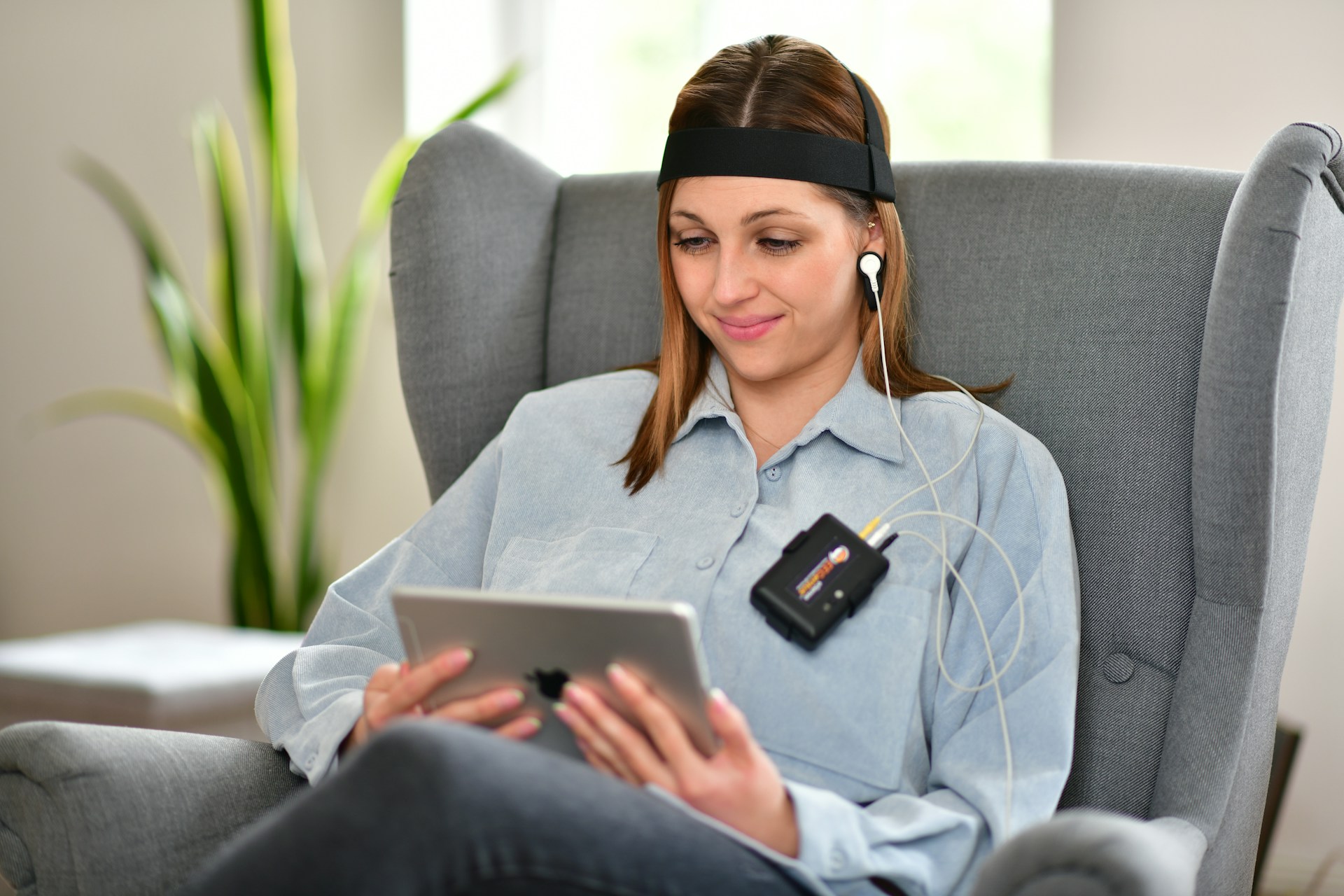
During a training session at our Fayette County facility, highly sensitive sensors are placed on your scalp. It is important to note that these sensors are passive; they do not deliver any electrical signals or shocks to your brain. They simply “listen” to your brain’s natural electrical output. The data is processed by sophisticated software and displayed to you through a movie or a visual game on a monitor.
When your brain hits the “target” frequency—for example, producing more calm Alpha waves—the movie plays brightly and the audio is clear. This is the reward. If your brain slips back into the dysregulated pattern (like an anxiety spike), the screen dims or the music fades. Because the brain is a reward-seeking organ, it subconsciously figures out how to keep the movie playing by firing the correct neural pathways.
Over the course of 20 to 40 sessions, these “sober” and “stable” pathways are strengthened until they become the brain’s new default setting, providing a foundation for long-term emotional regulation.
The Clinical Advantage of Neurofeedback in High-Acuity Care
Integrating neurofeedback into a residential mental health track offers several unique clinical advantages that outpatient providers cannot match.
1. Permanent Structural Change
Unlike psychiatric medication, which only works while the chemical is in your bloodstream, neurofeedback creates structural changes in the brain’s neural networks. Once the brain learns how to self-regulate, it retains that “muscle memory” long after you leave our care.
2. Zero Systemic Side Effects
Because there are no pharmaceutical chemicals involved, neurofeedback does not cause weight gain, sexual dysfunction, or the emotional blunting often associated with high-dose antidepressants or anti-anxiety meds. This makes it an ideal modality for individuals who are sensitive to medications.
3. Synergy with Behavioral Therapies
By calming the physical nervous system first, neurofeedback creates the biological “headspace” necessary for Cognitive Behavioral Therapy (CBT) and DBT to actually take root. When your brain isn’t in a state of constant panic, you can finally focus on the skills needed to manage your life.
Train Your Brain for a Stable Future
You have spent enough of your life feeling like a victim of your own neurobiology. It is time to take control. Neurofeedback isn’t just about feeling better temporarily; it is about building a brain that is resilient and stable.
Peachtree Wellness Solutions is the premier destination for technology-forward psychiatric care in the South Metro Atlanta area. We are proudly in-network with Optum and Tricare East, ensuring that this life-changing technology is accessible.
Contact our admissions team today for a free verification of benefits and start your journey toward neurological peace in Peachtree City.
Frequently Asked Questions About Neurofeedback Therapy and Training the Brain
Absolutely not. This is a common misconception. Neurofeedback is 100% passive and non-invasive. The sensors only read your brain’s natural electricity; they do not transmit any current. It is as safe as listening to a heart monitor.
Because neurofeedback is a learning process (like learning to swim or ride a bike), the results are generally highly durable. Once the brain creates these new, more efficient neural pathways, it tends to remain in those patterns unless a major new trauma occurs.
When integrated into our comprehensive residential or PHP mental health programs, neurofeedback is typically covered as part of your medically necessary treatment plan. We are in-network with Optum/UHC and Tricare East. Call us for a free benefits check.
Sources
- Patil, A. U., et al. (2023). Review of EEG-based neurofeedback as a therapeutic intervention to treat depression and anxiety. Psychiatry Research: Neuroimaging. Retrieved from: https://pubmed.ncbi.nlm.nih.gov/36682174/. Accessed on April 29, 2026.
- National Institute of Mental Health. (2024). Technology and the Future of Mental Health Treatment. Retrieved from: https://www.nimh.nih.gov/health/topics/technology-and-the-future-of-mental-health-treatment. Accessed on April 30, 2026.
- International Society for Neuroregulation & Research. (2023). Clinical Efficacy of Neurofeedback for SMI. Retrieved from: https://isnr.org/. Accessed on April 30, 2026.
- Hammond, D. C. (2011). What is Neurofeedback: An Update. Journal of Neurotherapy. Retrieved from: https://www.isnr-jnt.org/article/view/16553. Accessed on April 30, 2026.

