

Outpatient Mental Health Care for Tampa Adults in Georgia
Our program is in Peachtree City, Georgia, roughly seven hours north of Hillsborough County. For Tampa families, particularly military households, the coverage question and the distance question have different answers, and both are worth knowing before you call.
Tampa in September is still summer, and the people out on Bayshore before six are the ones who have worked out that the rest of the day belongs to the heat. Some of them are running off a bad night. A spouse who could not sleep again, a veteran who has stopped answering the group text, a nurse coming off a shift at Tampa General who has been holding a lot of other people’s emergencies and none of her own.
Peachtree Wellness Solutions provides adult outpatient mental health treatment on the south side of metro Atlanta, and Florida is among the states we serve. Tampa is a long way from Fayette County, and no amount of framing changes that. What does change the calculation for some households is coverage, because a TRICARE card behaves the same in Georgia as it does in Hillsborough County, and finding structured behavioral health care that takes it is harder than it should be.
The MacDill Factor
Tampa is a military town in a way that shapes its whole behavioral health picture. MacDill Air Force Base sits at the end of the peninsula in South Tampa, home to two combatant commands, and the population attached to it reaches far past the fence line: active duty, reservists, retirees who settled here after a final tour, contractors, and the spouses and adult children who carry the deployments alongside them.
That population has a documented relationship with substance use that runs against the stereotype. Federal survey data has found past-year illicit drug use under 1 percent across the branches, with prescription misuse just over 4 percent. Where the difference shows up is alcohol: binge drinking at around 30 percent among active-duty personnel compared with roughly 25 percent of civilians. The pattern in military communities is much less about illicit drugs than about drinking that stays inside what the culture treats as normal until it very much is not. Multiple deployments, combat exposure, and combat injury are all associated with higher risk.
The other half of the picture is what TRICARE actually covers, which is more than most families assume. TRICARE publishes substance use disorder treatment as a covered service, and mental health care alongside it. Knowing that a benefit exists is different from finding a program that takes it, and that gap is where a lot of military families give up. Peachtree Wellness Solutions is in-network with TRICARE East Select and Prime.
Seven Hours Is a Decision, Not a Drive to Work
Start with the map, because everything else follows from it. From Tampa it is I-275 to I-75 north, then a long straight run through Ocala, Gainesville, Lake City, Valdosta, Tifton, and Macon before the Atlanta metro, dropping southwest on GA-74 into Peachtree City. Around 460 miles. Seven hours if you barely stop, more if you do. Flying is faster by a wide margin: Tampa International to Hartsfield-Jackson is a little over an hour in the air, with roughly 45 minutes southwest from the terminals.
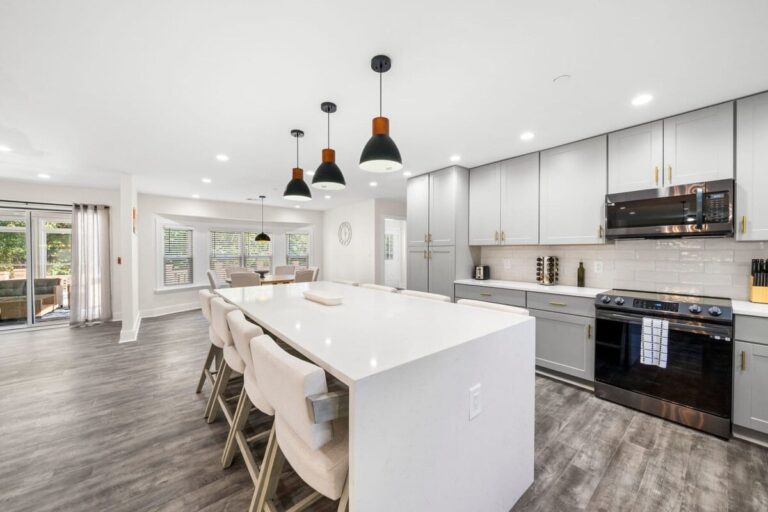
Programming is in person at Governors Trace on weekday mornings. Nobody drives up from Hillsborough County for a Tuesday group and sleeps at home. Coming here from Tampa means staying in the area for the length of the program, which is a housing conversation as much as a clinical one, and our admissions team works through it rather than expecting you to have solved it first.
Some people choose that distance deliberately, and the reasoning holds up. An illness attaches itself to a specific life: the same drive across the Howard Frankland, the same three people, the same room at 11 p.m. Treating it inside that architecture means fighting the architecture every night. It also means being seen. In a base community, where the neighborhood and the workplace and the social circle are frequently the same set of people, privacy is not a vanity concern. It is often the thing that decides whether someone gets help at all.
What Florida Has, and What It Is Short Of
Florida’s behavioral health system runs through the Department of Children and Families, which contracts with regional managing entities to deliver publicly funded mental health and substance use services. Hillsborough County has real capacity: hospital behavioral health units, a large network of outpatient providers, and the specialized services that come with a metro of this size. If tonight is an emergency, local crisis services and 988 come first, and nothing here should be read as a reason to travel instead of getting immediate help.
What is thin here is the same thing that is thin nearly everywhere. Between a crisis stabilization unit measured in days and an outpatient appointment measured in months sits the structured, several-days-a-week level of care, and there is not enough of it. Add the specific constraint of a network that takes TRICARE, and the list of realistic options for a Tampa military family gets short quickly. That combination is the most common reason a Hillsborough County household ends up looking at Georgia.
What Treatment Actually Involves
Outpatient care comes at two intensities. A partial hospitalization program fills most of a weekday and fits someone whose functioning has come apart, past the acute danger but nowhere near steady. An intensive outpatient program takes about three hours a morning and leaves the day workable. People usually move from one to the other rather than picking once.
Coverage, Stated Directly
Network status follows the plan, not the state line. Peachtree Wellness Solutions is in-network with TRICARE East Select and Prime, and with Optum, which covers UnitedHealthcare, UMR, Oscar, and Surest plans. A Tampa household carrying one of those is in-network here in the same way it would be at home.
Federal parity law requires most plans covering mental health and substance use benefits to apply comparable rules to them as to medical and surgical care, which is the reason this level of treatment is a covered benefit rather than a discretionary one. It does not make plans identical. TRICARE has its own referral and authorization rules depending on whether you are Prime or Select and whether the beneficiary is active duty. Commercial plans have their own deductibles and length-of-stay review. Our admissions team reads your specific policy and tells you what it covers before an assessment rather than after, and if your plan is not one we contract with, you will hear that at the start.
We Work With Most Insurance
Most major health insurance plans with out-of-network benefits can cover the costs associated with our program. Find out your coverage options right now.





From Tampa, Find Out What Level of Care Fits
The first question is not whether to make a seven-hour drive. It is what the last six months actually call for, which a clinician can answer in a conversation and which no amount of searching at midnight will settle. Sometimes the answer is that this program fits and the travel is worth arranging. Sometimes it is that something in Hillsborough County serves better, and we will say so plainly. Spouses and parents call and ask their own questions first, without the person in question on the line, and that is a normal way to start. Reach the Peachtree Wellness Solutions admissions team and we will go through your benefits, including how TRICARE applies, and what a first week involves. If someone is in danger tonight, call or text 988 before anything else.
Faqs about Mental Health Treatment for Tampa Residents in Georgia
Peachtree Wellness Solutions is in-network with TRICARE East Select and Prime, and network status follows the plan rather than the state, so crossing from Florida into Georgia does not by itself put you out of network. TRICARE publishes both mental health care and substance use disorder treatment as covered services. Referral and prior-authorization rules differ depending on whether the beneficiary is Prime or Select and whether they are active duty, so the admissions team confirms exactly what applies to your situation before anyone is admitted.
About 460 miles and roughly seven hours, mostly I-75 north through Ocala, Gainesville, Lake City, Valdosta, and Macon before the Atlanta metro. No, it is not commutable. Programming happens in person on weekday mornings, so adults coming from Tampa arrange somewhere to stay locally for the length of the program. Flying shortens the trip considerably, with Tampa International to Hartsfield-Jackson a little over an hour in the air and about 45 minutes southwest to Peachtree City from there.
The federal survey data points that way. Past-year illicit drug use has been measured under 1 percent across the branches, with prescription misuse just over 4 percent, while binge drinking runs around 30 percent among active-duty personnel compared with roughly 25 percent of civilians. Risk rises with repeated deployments, with exposure to combat, and with having been wounded. That pattern matters because drinking that stays inside what a culture treats as normal is much harder for the person and the family to name as a problem.
No, and “nothing has happened yet” is the best time rather than the worst. An assessment is a conversation in which someone qualified hears what the past several months have looked like and says what level of care the situation calls for. That answer is frequently that something closer to home fits, in which case you have gotten a clear read from someone who evaluated it rather than a guess. If the situation is acute tonight, local crisis services and 988 come first.
Sources
- TRICARE. (n.d.). Substance use disorder treatment. Retrieved from: https://www.tricare.mil/CoveredServices/IsItCovered/SubstanceUseDisorderTreatment. Accessed on September 14, 2026.
- National Institute on Drug Abuse. (n.d.). Substance use and military life DrugFacts. Retrieved from: https://nida.nih.gov/publications/drugfacts/substance-use-military-life. Accessed on September 14, 2026.
- National Institute on Drug Abuse. (n.d.). Military life and substance use. Retrieved from: https://nida.nih.gov/research-topics/military-life-substance-use. Accessed on September 14, 2026.
- Florida Department of Children and Families. (n.d.). System of services and support. Retrieved from: https://www.myflfamilies.com/services/samh/treatment-services/AMH/system-of-services-and-support. Accessed on September 14, 2026.
- Centers for Medicare & Medicaid Services. (n.d.). The Mental Health Parity and Addiction Equity Act (MHPAEA). Retrieved from: https://www.cms.gov/marketplace/private-health-insurance/mental-health-parity-addiction-equity. Accessed on September 14, 2026.
- U.S. Department of Veterans Affairs, National Center for PTSD. (n.d.). PTSD: National Center for PTSD. Retrieved from: https://www.ptsd.va.gov/. Accessed on September 14, 2026.
Overview
- Where it is: 100 Governors Trace, Peachtree City, Georgia, at the south end of the Atlanta metro. About 460 miles and seven hours from Tampa, mostly I-75. This program is not located in Florida.
- What it is: Adult partial hospitalization and intensive outpatient mental health treatment, in person on weekday mornings, with co-occurring substance use addressed alongside.
- Military families: In-network with TRICARE East Select and Prime, which matters in a county built around MacDill Air Force Base.
- Other coverage: In-network with Optum, covering UnitedHealthcare, UMR, Oscar, and Surest plans.
- What it is not: Not a hospital, not residential, and not a commute. Seven hours makes this a relocation decision for the length of the program.